Locust Load Testing and Markov Chains
I recently read this blog post on the pains of load testing. I want to focus on two pain points pulled right out of the post:
- Most load testing tools support simplistic workloads, and even the complex ones don’t let you do everything that’s realistically needed to simulate real usage of a web application.
- Writing the test with a simulation of real usage is the hardest part, even if the tools do support what you need.
A Markov-what?
I also recently used Locust in a load testing scenario at work. We’re creating an AI chat agent (a new idea you might not have heard about) and I was tasked with doing some simple load testing.
I didn’t want to use the default load testing tools like ab, wrk, or vegeta for the same issues as 1.. Hitting the chat endpoint and sending a message as quick as possible didn’t simulate an end user that well.
In looking through the Locust docs, I found something interesting.
MarkovTaskSet (See docs)
The Locust docs explain it well.
For reference, a task in Locust is a load action (initiate an HTTP request) and a TaskSet is a collection of these actions.
MarkovTaskSet is a TaskSet that defines a probabilistic sequence of tasks. Unlike regular TaskSets where tasks are chosen randomly based on weight, MarkovTaskSets allow you to define specific transitions between tasks with associated probabilities.
This is useful for modeling user behavior where the next action depends on the current state.
The distinction here is that a task in a regular TaskSet can jump to ANY other task. These allow you to narrow down the next Task. The example shows how simple the usage can be:
class ShoppingBehavior(MarkovTaskSet):
    wait_time = constant(1)

    @transition("view_product")
    def browse_catalog(self):
        self.client.get("/catalog")

    @transitions({
        "add_to_cart": 3,
        "browse_catalog": 1,
        "checkout": 1
    })
    def view_product(self):
        self.client.get("/product/1")

    @transitions([
        "view_product",
        "checkout"
    ])
    def add_to_cart(self):
        self.client.post(
            "/cart/add",
            json={"product_id": 1}
        )

    @transition("browse_catalog")
    def checkout(self):
        self.client.post("/checkout")
With a couple of state transitions you have a non-trivial user emulation! Check out the interaction graph.
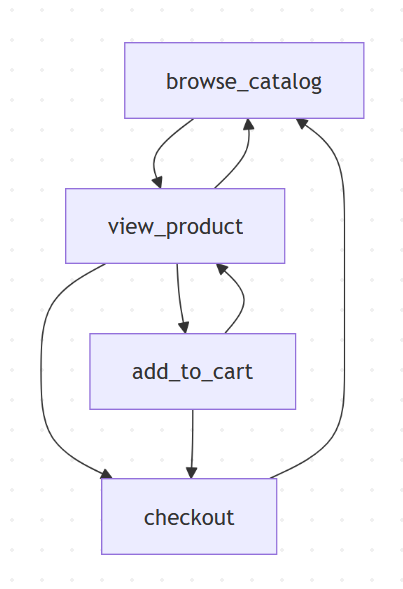
The key part here is that each transitions has a probability of going to a different state. On the aggregate this makes the load a lot more organic.
I ended up using this to emulate a user that would:
- Browse their profile
- Browse their chats
- Chat with a 10-15s pause to read. There was a 75% chance to send another message or go do another task.
And it wasn’t even 100 lines of code! Very very cool. I think the succinct-ness of the solution addresses 2. very well.
This idea of simple rules for individuals leading to a complex system behavior reminds me of Sebastian Lague’s excellent youtube video on Boids. It illustrates the concept beautifully in his ever-calm voice. Kinda like a chill teacher assistant who’s explaining the subject matter better than the professor ever did.
Recent Blog Posts
- 14 Jun 2026 Almost realtime deploy logs in my SaaS
- 08 Jun 2026 The long list of bad decisions I made for my new SaaS
- 13 Apr 2026 Your intuition of LLM token usage might be wrong
- 11 Feb 2026 Locust Load Testing and Markov Chains
- 20 Jan 2026 I love the old man minimap in VS Code
- 03 Jan 2026 On Resurrecting a 12 year old blog
- 09 Oct 2014 Updating a forked Git repo
- 06 Oct 2014 ADB access to remote server from local usb
- 30 Mar 2014 Bug Progress: Day 2
- 27 Mar 2014 Building the Emulator